
NEIGHBOURHOOD SPORTLIGHT: EAST BUNBURY
NEIGHBOURHOOD SPOTLIGHT: EAST BUNBURY
But beneath the relaxed suburban feel lies a neighbourhood packed with fascinating history, quirky stories and hidden gems.
A SUBURB BUILT AROUND WATER
East Bunbury sits beside the Leschenault Inlet, one of the reasons Bunbury is often called the "City of Three Waters." The suburb has long enjoyed a close relationship with the estuary, with generations of residents fishing, crabbing, boating and enjoying the waterfront lifestyle.
That connection to water has also shaped some of East Bunbury's more unusual history. For decades, flooding was a major concern in low-lying areas surrounding the inlet. Following severe flood events and the devastation caused by Cyclone Alby in 1978, the Bunbury Harbour Floodgates were completed in 1980 to help protect East Bunbury and surrounding neighbourhoods from storm surges and rising waters.
THE CURIOUS STORY BEHIND "THE PLUG"
One of Bunbury's most recognisable landmarks sits just moments from East Bunbury.
Locals know it simply as "The Plug" — a man-made barrier created in 1951 to close off the natural opening of the Leschenault Estuary. The project was designed to address ongoing silting issues affecting Bunbury Harbour, but it became part of a much bigger story involving flood management, harbour engineering and the changing shape of the city's coastline.
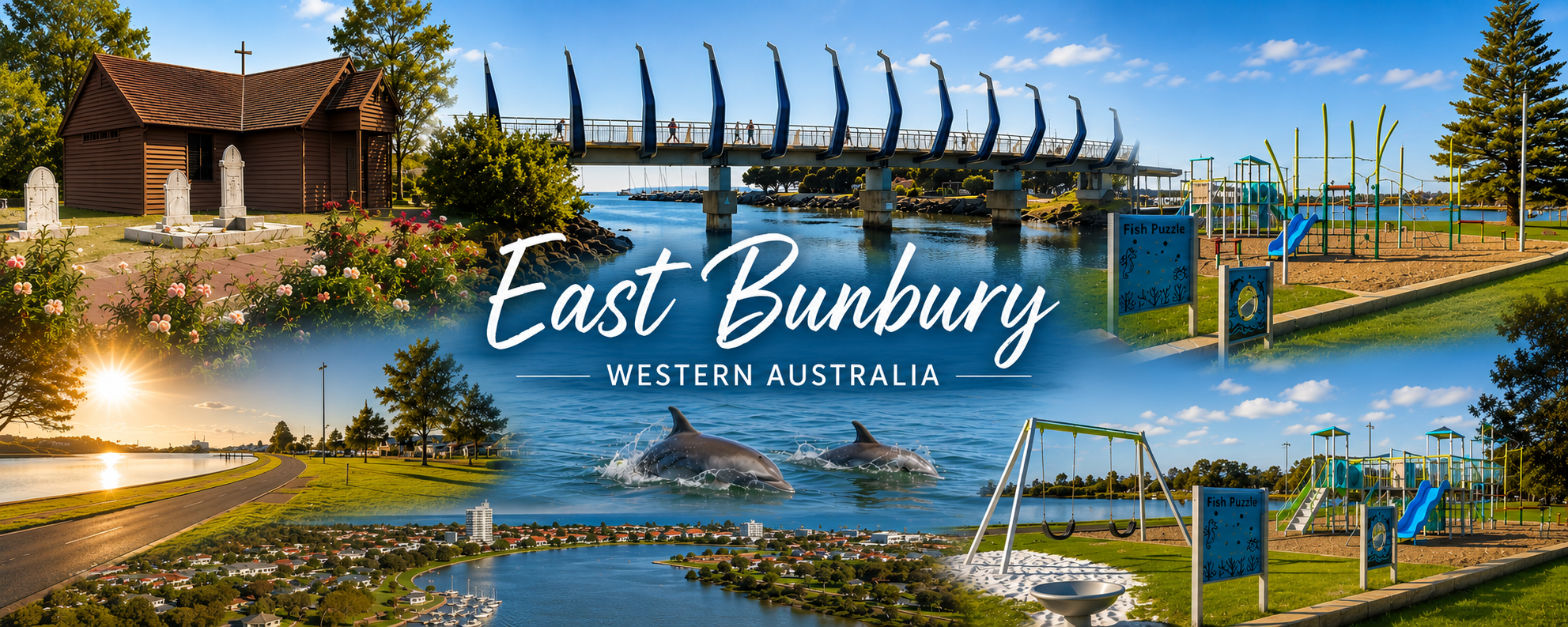
Today, The Plug is crossed by the striking Koombana Bay Footbridge, one of Bunbury's most photographed structures.
A FOOTBRIDGE INSPIRED BY SHIPWRECKS
At first glance, the Koombana Bay Footbridge looks like a modern piece of public art.
Look a little closer and you'll discover its design was inspired by the many shipwrecks hidden beneath the waters of Koombana Bay. The bridge's sweeping steel ribs were deliberately shaped to resemble the hull of an overturned ship, paying tribute to Bunbury's rich maritime past.
Even more interesting is the fact that parts of the structure reused an old railway bridge that once served the area's industrial operations.
A RAILWAY LEGACY STILL RUNNING TODAY
East Bunbury has long been connected to Western Australia's railway story.
The suburb is home to Bunbury Passenger Terminal, the current terminus of the famous Australind rail service linking Bunbury and Perth. The terminal opened in 1985, replacing the original station in the city centre.
For many South West families, the Australind wasn't just a train, it was the beginning of holidays, shopping trips and weekend adventures. Generations of locals have memories of arriving in Bunbury by rail, making the station an important part of East Bunbury's identity.
THE IRISH CONNECTION YOU MIGHT NOT KNOW ABOUT
One of East Bunbury's best-kept historical secrets is hidden in the name "Rathmines," the suburb's northern precinct.
The area was named after Rathmines in Ireland, the hometown of Reverend Joseph Withers, who arrived in Western Australia in 1864. After purchasing land near Bunbury, he later subdivided the property, giving rise to the neighbourhood name that still exists today.
Meanwhile, the southern portion of East Bunbury, known as Wollaston, was named after Reverend John Ramsden Wollaston, one of the region's earliest colonial chaplains.
HIDDEN HISTORY AROUND EVERY CORNER
East Bunbury is also home to St Mark's Anglican Church precinct, one of the oldest historic sites in the region. The area contains graves of some of Bunbury's earliest European settlers and offers a fascinating glimpse into the South West's pioneering years.
Adding another layer to the area's character is its strong multicultural influence, particularly from Italian families who helped shape Bunbury's growth throughout the twentieth century.
WHY LOCALS LOVE IT TODAY
While East Bunbury proudly celebrates its past, it's equally popular for its modern lifestyle appeal.
Residents enjoy easy access to Bunbury Forum, quality schools, sporting facilities, walking trails and the beautiful Leschenault Inlet. The suburb offers a mix of established homes, leafy streets and convenient transport links, all just minutes from Bunbury's CBD.
It's this combination of history, convenience and community spirit that continues to attract families, professionals and retirees alike.
East Bunbury may not always make the headlines, but its stories are woven through the history of Bunbury itself — from railway journeys and maritime mysteries to floodgates, shipwreck-inspired architecture and generations of local families who proudly call it home.

You might also be interested in
Jul 1, 2026
NEIGHBOURHOOD SPOTLIGHT: EATON
Eaton, WA: Riverside Living with Everyday Convenience Nestled on the banks of the Collie River, Eaton has grown into one of the South West's most desirable suburbs. Combining a relaxed lifestyle with

Jul 1, 2026
MODULAR HOMES VS TRADITIONAL HOMES
Modular Homes vs Traditional Homes: Which Option Is Right for You? If you're planning to build a new home, you've likely come across the growing popularity of modular homes. Once considered a niche o